Grow revenue without the chaos.
Most owner-led businesses hit a point where growing just means more mess. More people, more moving parts, more of it running through you. I step in and lock arms with you.
A free 30-minute call.
Owners and teams I've worked with





Most people call me at about the same point.
The business works. Revenue's up, the phone rings, the work gets out the door. But everything runs through you. You approve the quote before it goes. You know why the schedule slipped, because you're the one who went and found out.
You've thought about taking two weeks off and quietly decided this isn't the year.
Nobody planned it that way. It happened while you were busy running the place. And when I get in there, it almost always traces back to one of two things.
Every business does two things.
1
Get customers
You have to find people and get them to buy.
Sound familiar?
- “When I stop selling, the sales stop.”
- “Our close rate keeps slipping and I can't tell you why.”
- “Leads come in, then just seem to disappear.”
2
Serve those customers
You have to deliver, and keep them coming back.
Sound familiar?
- “The team can't run the work without me watching it.”
- “We win the customer, then the wheels come off in delivery.”
- “Everything that makes this place work is in my head, not a system.”
Whatever you're wrestling with lives in one of those two. And it's almost never the one you think.
And underneath both, the calls only you can make
- “I need to hire, but is it a salesperson or an operator?”
- “I've got capital to put to work and don't know where it actually moves the needle.”
- “Is it time for a second location, or would that just multiply the chaos?”
- “I hit the revenue number, so why is there no cash in the bank?”
- “I couldn't take a two-week vacation without the whole thing wobbling.”
Not everyone who calls me is stuck.
Plenty of them weren't stuck at all. The business worked. They just wanted it bigger. A second location. A new market. A product that's been sitting on the shelf for two years.
Same conversation. We map how you make money now, then figure out what has to hold when you double it. Growth breaks things that were fine at the old size.

Hi, I'm Cameron.
I've spent my career operating inside owner-led businesses. These days I run operations at a health tech company, and alongside that I work with a handful of owners on the stuff that quietly caps growth.
More often than not I end up building the fix rather than writing a report about it. A lot of that is AI and automation now. The work that was eating hours out of your week starts running on its own, and you get those hours back.
More about how I work →What working with me looks like.
Step one
We have a conversation
We talk for half an hour. I learn a little about your business: what's keeping you up at night, what you think is holding growth back, what you're stressed about.
I do this part for free. After the call I'll send you a roadmap of what I'd look to fix. You can hand that to your own team and implement it yourselves. If it's not something you should be doing, I'll parachute in.
Step two
I get in there with you
I get in the ground with you and learn more. We both agree on what's going on, and on what those improvements would actually result in, whether that's the financial model, your personal life, hours worked, or stress.
I don't give you pricing or a quote until we've identified how painful the issue is and what it's costing the business.
Step three
We agree on what to fix
You and I agree on what we should fix and how I'd approach it. Everything I do has to result in a measurable impact to your financial model, your sales, or your personal life.
This could be a lot of different things. Sometimes it's sales process, market messaging and lead generation. Sometimes it's OKRs and goal setting. Sometimes it's building a financial model or redoing processes. I can develop my own automations, or I could just stand in as your business partner and COO on an interim basis.
Step four
I stand in the gap with you
I'm allergic to too much advice and consulting. You don't need more advice, you need execution and change. So I'm in it with you, doing the work next to your team.
Cameron got deep into our data and market and helped us get much more focused on where we should actually be spending our sales and marketing effort. He helped us turn that into a repeatable go-to-market motion, and within three months we generated 20 hospital opportunities representing $3.5M in qualified pipeline.
Sanjay S.
Founder, Omnicure
Working with Cameron, we increased utilization, patients in seats, from 55% to 80% without adding any additional headcount. I was shocked by how quickly he was able to diagnose where we were getting stuck and then partner with us to fix it.
Dr. Bryce C.
Owner, Restoration Chiropractic
Often the fix turns out to be software.
It used to be that an operator could only tell you what was broken. Now you can go build the thing that fixes it. I write these myself, so the work that was eating your week starts running without you standing over it.
10 hrs → 1
What it takes a construction team to price a job, before and after the quote builder I wrote them.
$12K
Unbilled work a timesheet bot turned up on the day it went live, and every week since.
10 hrs/week
Back on the calendar of a founder running a raise, once the agents took over the prep and follow-ups.
Not ready to talk yet?
Answer six honest questions and the diagnostic will tell you the one thing I'd fix first, and why. Two minutes, and you never have to speak to me to get it.
Take the diagnosticThis is what it actually looks like.
That's a photo from a real session. I'm not interested in handing you a document you'll never open. I'd rather get in a room with you, real or virtual, and map out how you actually get customers and how you serve them. Where it stalls. Where the friction is.
By the end it's all on one board, and the most expensive problem usually shows itself. We put a number on that one, and then I dive in and don't stop until it's fixed.
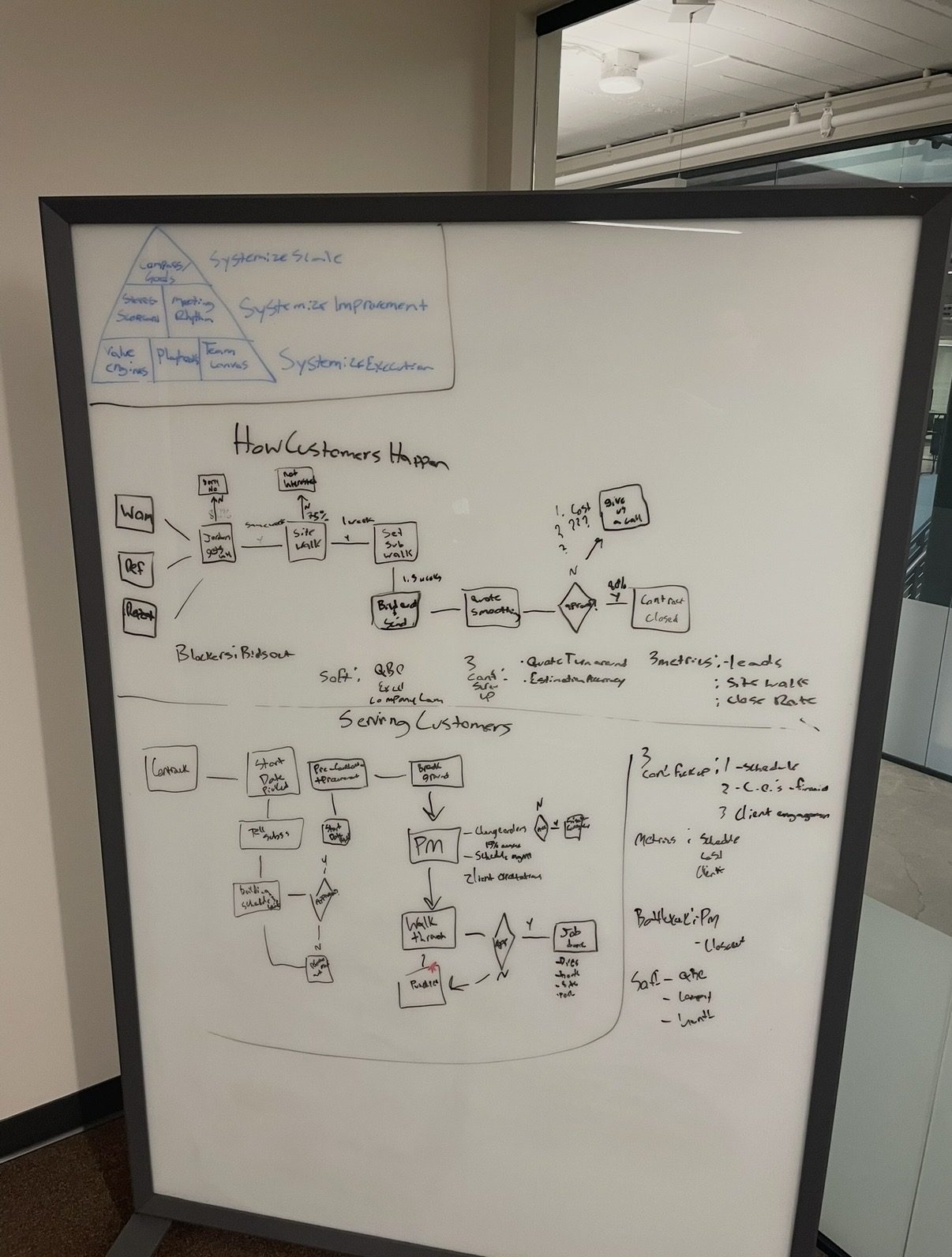
It all starts with the map.
Understanding how your business actually makes money.
01
I map how you make money
Every way you get a customer, and everything you do to keep them. Just this alone opens your eyes to the opportunities you're wasting.
02
We see what it takes to deliver
What each part actually needs to run: people, technology, resources.
03
We find the one thing to fix first
The bottleneck that keeps rearing its head until we eliminate it. I help you knock it out, then we go find the next one.
04
We keep it running
A simple rhythm the team can hold on their own, so everyone knows their number and their job, and you can finally see what's working without standing over it.
And then you've got a machine.
You don't run a factory, but your business works like one. Read it left to right: leads come in, you win the work, you deliver it, revenue comes out the other end.
Swipe the diagram to see the whole line.
Questions you might have.
What's a fractional COO? +
An operator who runs alongside you part-time instead of joining full-time. I get into the business, find what's really holding growth back, and fix it with your team, without the cost of a full-time exec.
Who do you work with? +
Owner-led businesses, roughly $1M to $20M in revenue, across construction, professional services, healthcare, software, and agencies. If you've become the bottleneck and growth has gotten chaotic, that's my wheelhouse.
What happens on the call? +
Thirty minutes, no pitch. You tell me where it's stuck, I tell you what I'd fix first. You can run with that yourself, or we can talk about doing it together.
What does it cost? +
I don't price anything before I understand the problem. Once I do, the price is tied to what fixing it is worth to you rather than to hours. You'll have the number before anything starts, and I'll tell you if I don't think it's worth doing.
Do you work remotely? +
Yes. I work remotely with owners across the US, and get on-site when the work calls for it.
If you doubled your sales tomorrow, would you be happy, or freak out?
He was chasing more sales, but when I asked him that he got sick to his stomach. He had a throughput problem, not a sales problem. We fixed how the work got delivered and the growth followed.
There are a few more like that over on the results page.
See the results